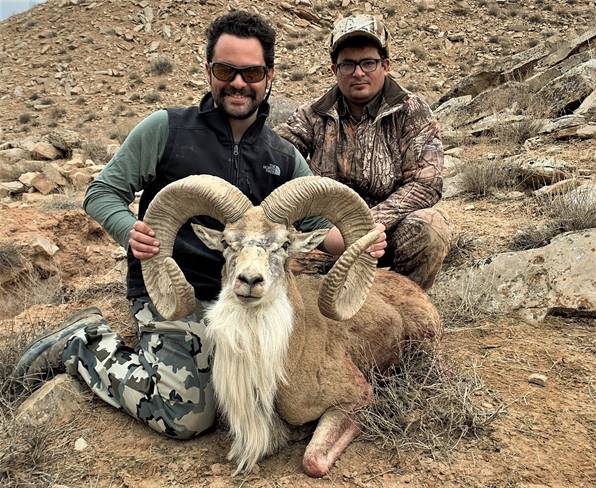
Transcaspian Urial
Among the world’s lesser-known wild sheep, the Transcaspian Urial stands out for its striking appearance, remote habitat, and rarity as a huntable species. Found in the rugged and arid landscapes of Uzbekistan, it inhabits some of the most unforgiving terrain south of the Ustyurt Plateau, including Kazakhly–Kaplankyr, the “Dry Lake,” the cliffs of the Sarykamysh Depression, and the eastern reaches of the southern chinks.
Specie / Hunt Description
The highly coveted and imposing Transcaspian Urial are one of the rarer huntable members of the Urial family. But they widespread in parts of Uzbekistan, particularly the arid desert south of Ustyurt, mainly in the areas of Kazakhly–Kaplankyr, “Dry Lake”, along the cliffs of the Sarykamysh depression, and in the eastern part of the southern chinks.
The species is part of a cross-border population that migrates between Uzbekistan, Kazakhstan, and Turkmenistan.
Their white manes and relative rarity project as a stunning member of the Urial family, growing to 80-90 centimeters (31-35 inches) at shoulder height. The horns of mature males measure about 100 centimeters (39 inches) long.
Extremely limited permits implies a significant cost to hunt them. The upside is high success on this trophy through the knowledge and outfitting abilities of our local hunting team.
Getting There: Hunters will be met in Tashkent and assisted with firearms clearance and will take a connecting flight to Nukus, closest to the hunting area. Hunting takes place in the Karakalpak region where hunters are accommodated in a fly camp reachable by an 8-hour drive.
Hunt Strategy: Transcaspian Urial are not true high‑altitude sheep. They are hunted almost entirely in low‑ to mid‑elevation desert mountain systems, typically 300–900 meters (1,000–3,000 ft) above sea level. Transcaspian urial live in open, broken desert escarpments. The hunt is won or lost with optics – glassing from high chink rims or plateau edges to identify ram groups moving between shade pockets and feeding and tracking their horizontal movement across cliff systems. This is a horizontal chess match, not a typical vertical climb for sheep.
Shots are typically long – from 300-400 meters (approx. 325-425 yds.) on average.
Season: Late October through March is the prime window — with December–February being the absolute peak for trophy quality, visibility, and rut-driven behavior.
Length of Hunt: The duration of the hunt varies between 2 to 6 days plus 2 in-country travel days.
Options: Various combination hunts with Transcaspian Urial are possible, including Bukhara Urial, Severtzov Argali, Black-tailed Gazelle, Mid-Asian Ibex, Bukhara Deer, and Wild Boar.
Please inquire for more information about seasons and other individual and combination hunt options in Uzbekistan.